

Your marketing campaigns, automated onboarding flows, and flash sale alerts are up against a silent, invisible barrier. Instead of just being banished to the spam folder, non-compliant messages are now being deleted at the server level. Your customers never even get the chance to see them.
Triggered by sweeping security upgrades from the major inbox providers, the digital communication landscape has completely transformed. The days of lenient spam filtering are gone; today’s algorithms are designed to aggressively reject unverified senders at the gate. Adapting to the email sending rules 2026 is no longer a minor IT checklist item—it is an absolute necessity for protecting your company’s bottom line.
If you operate a SaaS platform, an e-commerce brand, or a growth agency, ignoring the demand for strict bulk email compliance guarantees your highest-converting campaigns will simply vanish into the void. Even more dangerously, repeated missteps can result in your primary domain being permanently blacklisted.
In the following guide, we will unpack exactly why these strict inbox barriers were erected, the mandatory technical shifts you need to deploy immediately, and how to bulletproof your sender reputation in this new zero-tolerance environment.
Why 2026 is the Year of the Inbox Purge
The era of “spray and pray” email marketing is officially dead. Mailbox providers are prioritizing user experience and strict cybersecurity above all else. This has triggered three massive shifts in how your incoming mail is judged:
1. The Zero-Tolerance Spam Threshold
In the past, you might have survived a temporary spike in spam complaints after an aggressive marketing blast. Today, that leniency is entirely gone. Mailbox providers now operate on strict, automated numerical thresholds. If your audience repeatedly marks your messages as spam, your domain reputation plummets in real time, triggering automated blockades across your entire network.
2. Hyper-Personalized AI Filtering
Modern spam filters no longer just scan for “spammy” keywords. They deploy advanced machine learning to analyze user engagement on a hyper-individualized level. These algorithms track exactly how long a user reads an email, whether they reply, how quickly they delete it, and if they rescue your messages from the spam folder. If the AI determines your audience is chronically bored or unengaged, your sender reputation will degrade silently.
3. Strict Domain-Level Accountability
Mailbox providers now enforce rigorous domain-level accountability. This means the reputation of your marketing subdomains is permanently tethered to your primary brand domain. You can no longer burn through disposable sending domains without inflicting fatal collateral damage on your core business identity. Trust must be maintained across your entire digital footprint.
The Non-Negotiable Email Sending Rules You Must Follow in 2026
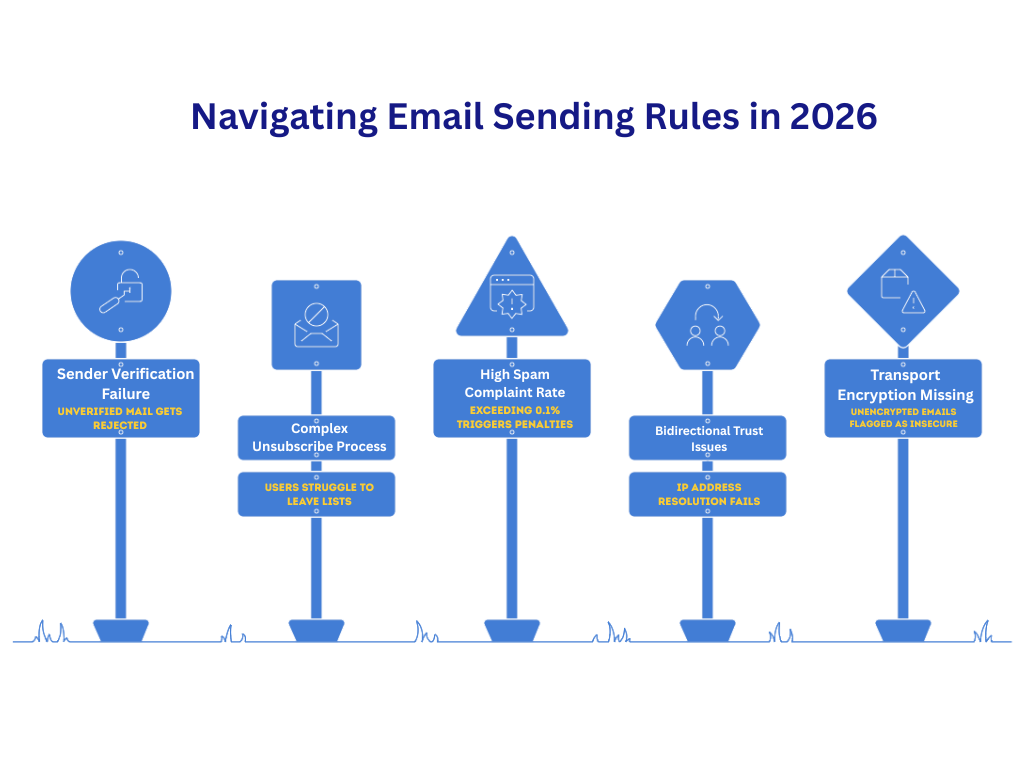
To guarantee your messages survive the purge and reach your target audience, businesses must adhere strictly to these non-negotiable operational standards.
Rule 1: Bulletproof Cryptographic Sender Verification
You must mathematically prove you are exactly who you say you are. No unverified mail gets through the gates in 2026. To comply, your technical setup must include three layers of identity proof:
- Authorized Server Lists: You must publish a public, verifiable DNS record that explicitly lists the exact IP addresses authorized to send emails on behalf of your brand. If an email comes from an unlisted server, it will be rejected.
- Encrypted Message Signatures: Every single email leaving your servers must carry a hidden, cryptographic signature. When the receiving server gets your email, it decrypts this signature to verify that the message content was not tampered with in transit.
- Strict Impersonation Policies: You must instruct mailbox providers on exactly what to do if they receive an email claiming to be from you that fails the above checks. You must enforce a strict policy that tells providers to automatically reject or quarantine any unauthorized emails attempting to spoof your brand.
Rule 2: The Seamless One-Click Escape Route
If a user wants to leave your list, it must be completely effortless. Major mailbox providers now mandate a universal, one-click unsubscribe mechanism for all commercial messages.
What this means: You must embed specific, standardized code headers into your email framework. When a user clicks the native “Unsubscribe” button at the very top of their email app interface (like Gmail or Apple Mail), they must be removed from your list instantly in the background. Do not force them to visit a landing page, log in, or manage preferences.
Rule 3: The 0.1% Spam Complaint Mandate
The absolute golden rule of bulk email compliance is maintaining an ultra-low user complaint rate.
- The Target: Keep your complaint rate consistently below 0.1% (which equals just one single complaint per 1,000 delivered emails).
- The Danger Zone: If you hit or exceed a 0.3% complaint rate, you will face immediate, severe consequences, including intense rate-limiting and total domain blocking.
Rule 4: Bidirectional Infrastructure Trust
Before a mailbox provider even looks at the content of your email, they run a background check on your delivering IP address. Your sending IP must have a valid record that resolves to a specific hostname, and that hostname must resolve perfectly back to the exact same IP address. This bidirectional trust proves your network infrastructure is legitimate and professionally managed.
Rule 5: Mandatory Transport Encryption
Data privacy is not optional. Unencrypted emails are heavily penalized and flagged with terrifying red security warnings in the user’s inbox. Every message you send must be transmitted over a secure Transport Layer Security (TLS) connection, ensuring that the communication between your sending server and the receiving server cannot be intercepted.
The 2026 Bulk Email Compliance Checklist

Achieving compliance is not a one-time setup; it requires rigorous, ongoing oversight. Use this actionable checklist to audit your operations and protect your domain:
Audit Identity Alignment: Ensure your authorized server lists and cryptographic signatures perfectly match your exact “From” address domain.
Enforce Rejection Policies: Upgrade your domain’s security settings to actively reject any unauthorized senders trying to impersonate your business.
Test Native Unsubscribe: Send a test campaign to major inbox providers and verify that the native, one-click unsubscribe header processes opt-outs instantly without redirecting to a landing page.
Monitor Provider Dashboards: Claim and actively monitor your domain on provider-specific dashboards (like Google Postmaster Tools) to track your exact spam complaint rates and reputation scores.
Secure Network Routing: Confirm your bidirectional DNS trust is accurately configured for every dedicated IP address your marketing team uses.
Clean Up HTML Formatting: Ensure your code is lightweight, mobile-responsive, and entirely free of deceptive formatting techniques that trigger algorithmic red flags.
Deliverability Killers: What Will Get You Blacklisted in 2026
Even flawless technical infrastructure cannot save you from toxic sending habits. Avoid these critical mistakes:
1. Purchasing or Scraping Email Lists
Buying lists is a catastrophic error. These lists inherently violate the rules of consent and are deliberately seeded with hidden “spam traps” created by security organizations solely to catch spammers. Hitting a single spam trap can instantly obliterate your domain reputation globally.
2. Ignoring “Graymail” and Unengaged Users
Allowing dormant subscribers to sit on your list indefinitely destroys your AI engagement score. If a user hasn’t opened or clicked an email in 90 to 120 days, continuing to barrage them with marketing messages tells mailbox providers that you do not care about list hygiene or user experience.
3. Firing High Volumes Without a Warm-Up
You cannot suddenly send 100,000 emails from a brand-new domain or a newly provisioned IP address. Mailbox providers treat massive, unverified volume spikes with extreme suspicion, usually resulting in immediate throttling. You must utilize a systematic warm-up strategy, starting with a tiny volume of highly engaged users and gradually increasing your output.
4. Sending from a “No-Reply” Address
Using a ” no-reply@ ” address is a terrible practice. It frustrates users, prevents them from adding you to their safe sender list, and signals to spam filters that you are not interested in two-way communication. Always use a monitored, friendly “Reply-To” address to encourage replies, which actively boosts your reputation score.
Future-Proofing Your Email Infrastructure
Protecting your inbox placement requires a strategic blend of infrastructure management and proactive data hygiene.
- Subdomain Segregation: Never mix your critical transactional emails (like SaaS billing receipts or password resets) with your promotional newsletters. Separate your mail streams using dedicated subdomains (e.g., marketing.yourbrand.com and alerts.yourbrand.com). If a marketing blast gets flagged, your transactional mail remains completely safe.
- API-Driven List Cleaning: Stop bad data at the door. Integrate a real-time email verification tool directly into your signup forms and checkout flows. This prevents typos, fake addresses, and known chronic complainers from ever polluting your database.
- Automated Sunset Policies: Implement strict, automated workflows in your CRM that silently remove or suppress contacts who stop engaging. Protecting your list quality is vastly more important than boasting a massive, inactive subscriber count.
Conclusion
The shift toward stricter deliverability regulations represents a permanent evolution in the digital landscape. By fully understanding and adapting to the new email sending rules 2026, businesses can turn strict compliance into a massive competitive advantage. While your competitors watch their promotional campaigns disappear silently into the spam folder, your brand will consistently dominate the primary inbox — driving higher engagement, deeper customer trust, and greater long-term revenue.
Do not wait until your critical launch emails start bouncing or your primary domain gets blacklisted. Secure your sending reputation today.
Ready to survive the inbox purge and escape the spam folder forever? Contact Postyman today for a comprehensive deliverability audit, and let our experts bulletproof your bulk email compliance.