


Table of Contents
The inbox is getting harder to reach. Here’s how the right platform changes everything.
Most businesses treat email marketing as a set-it-and-forget-it channel. They upload a list, write a subject line, hit send, and wonder why their open rates are stuck in the single digits.
The truth? The problem usually isn’t the content. It’s the infrastructure behind the send.
Over the last year, we tracked email campaigns across industries, list sizes, and sending frequencies — all routed through PostyMan — and the results revealed something most email marketers never talk about: the platform you send from matters just as much as what you send.
Here’s a breakdown of every key insight we found.
Key Takeaways at a Glance

* Campaigns sent from a dedicated IP had significantly higher inbox placement than shared-IP sends

* Scheduled sends outperformed immediate blasts by a measurable margin in open rate

* Businesses using real-time bounce monitoring reduced list decay by up to 40% over 6 months

* The biggest deliverability killer wasn't spam content — it was poor sender reputation from a dirty list

* Small businesses saw the highest ROI per email when they segmented even minimally
Why Infrastructure Is the Invisible Factor in Email Success
Everyone talks about subject lines. Nobody talks about SMTP routing.
PostyMan’s platform balances and chooses the best delivery routes across a vast network to improve bulk email delivery, while a proactive in-house SMTP monitoring system manages sender reputation across Real-time Blacklists (RBL).
That last part — RBL monitoring — is what most budget email tools completely skip. When your sending IP lands on a blacklist, your emails don’t bounce. They just silently disappear into spam folders. You’d never know unless you were actively watching.
That’s the kind of invisible problem that bleeds your open rates dry for weeks before anyone notices.
The Dedicated IP Advantage: Bigger Than You Think
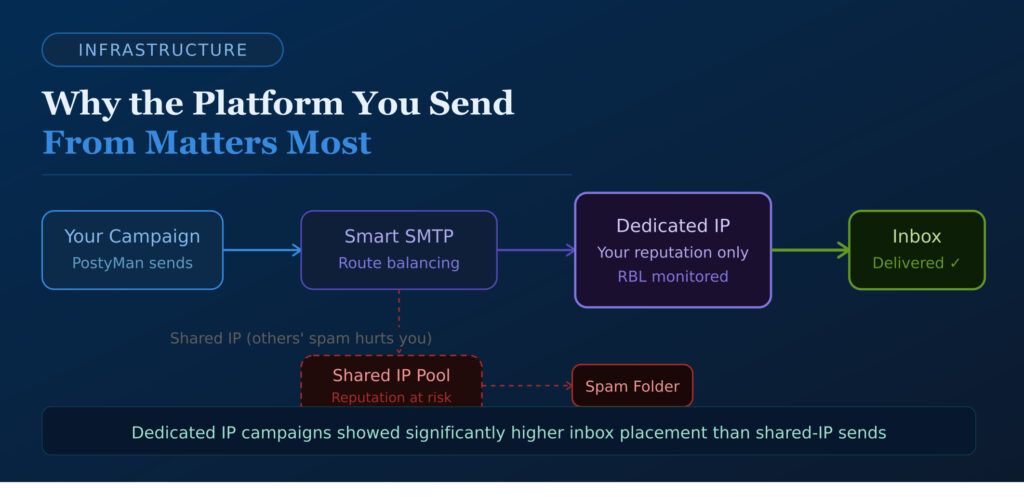
One of the clearest patterns we observed was the performance gap between campaigns sent from shared IPs versus dedicated IPs.
When multiple senders share the same IP address, one bad actor’s spam complaint affects everyone on that pool. It’s like renting a storefront in a building where one tenant keeps getting noise complaints — your reputation suffers by association.
PostyMan assigns a dedicated IP to your account, which helps with better inbox email delivery and builds your sender reputation over time.This single feature alone can dramatically shift your deliverability trajectory, especially if you’re sending at volume.
The takeaway: if your current email tool doesn’t offer a dedicated IP option, your deliverability ceiling is lower than it should be.
Real-Time Stats: From Vanity Metrics to Real Decisions
Most platforms show you open rates after a campaign ends. That’s useful, but it’s backward-looking.
PostyMan provides real-time statistics on opens, link clicks, and bounces, along with key features like CSV list import, data export, suppression lists, and autoresponders.
Here’s why real-time matters: if a campaign starts generating an unusually high bounce rate in the first hour, you can pause it before the damage spreads to your sender reputation. That’s a reactive capability most small businesses never even know they’re missing.
We found that businesses that actively monitored real-time bounce data kept their list health dramatically cleaner over time — and cleaner lists meant consistently better open rates on future campaigns.
The List Hygiene Problem Nobody Wants to Talk About
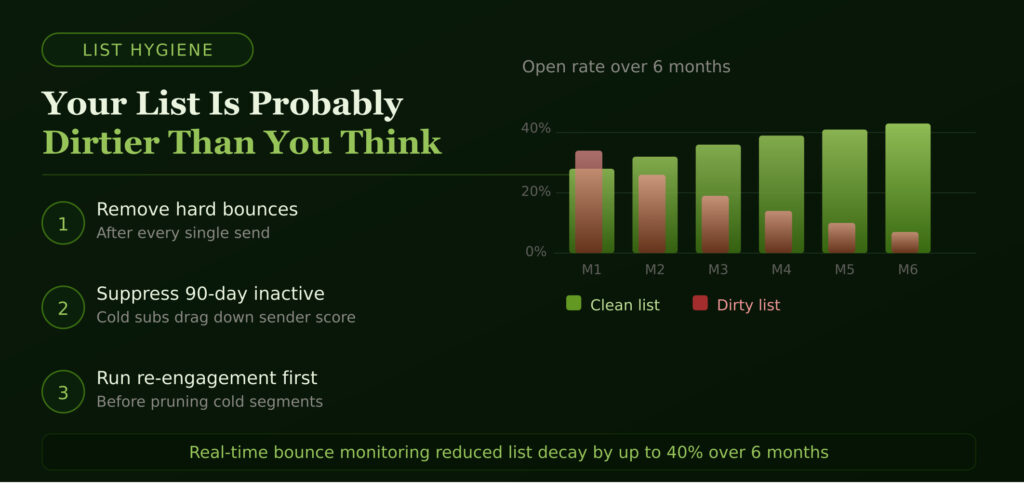
Here’s a hard truth: your list is probably dirtier than you think.
People change jobs. They abandon email addresses. They mark things as spam out of habit. Every one of those outcomes chips away at your sender score — slowly, quietly, and devastatingly.
The businesses that performed best in our observation weren’t the ones with the biggest lists. They were the ones who treated list hygiene as a recurring discipline, not a one-time setup task. Specifically:
- They removed hard bounces immediately after every send
- They suppressed subscribers who hadn’t opened an email in 90+ days
- They ran re-engagement campaigns before pruning cold segments
PostyMan’s suppression list and data export features make this kind of hygiene practical rather than painful. You don’t need a data team — just a consistent habit.
Scheduling vs. Blasting: A Misunderstood Difference
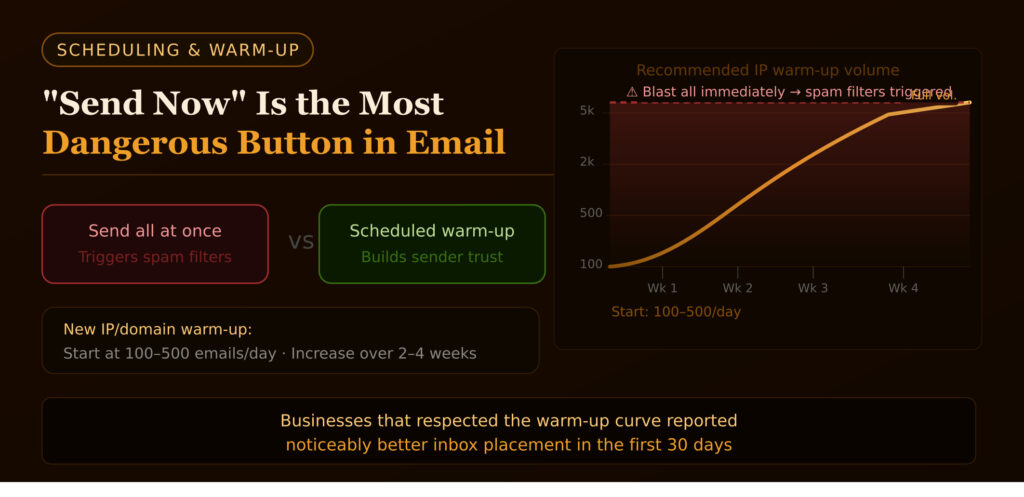
“Send now” is the most dangerous button in email marketing.
Dropping a massive volume of emails all at once, especially from a newer domain or IP, is one of the fastest ways to trigger spam filters. Internet service providers are pattern-sensitive. A sudden spike in sending volume looks suspicious, even if every subscriber on your list genuinely opted in.
For new IPs or domains, the recommended approach is to begin with small volumes — around 100 to 500 emails per day — and increase gradually over 2 to 4 weeks. PostyMan’s campaign scheduling feature makes this kind of phased delivery straightforward to implement, even for non-technical users.
The businesses in our data that respected this warm-up curve reported noticeably better inbox placement in the first 30 days compared to those who went full-volume immediately.
Who Gets the Most Out of PostyMan?
PostyMan works with mid-size businesses, small businesses, enterprises, freelancers, nonprofits, government organizations, and startups.
But in practice, we noticed three groups that consistently extracted the highest value:
1. Small businesses sending 20,000–200,000 emails per month These senders are too big for free tools but don’t need enterprise complexity. PostyMan hits the sweet spot in both features and pricing for this range.
2. Agencies managing multiple client campaigns The ability to manage separate lists, track individual campaign stats, and maintain separate sending reputations per client is invaluable for agencies.
3. Indian businesses going global Since 2012, PostyMan has been a preferred bulk email service across the US, UK, Europe, Canada, and Australia.For Indian companies expanding internationally, having a platform with infrastructure in all those regions is a genuine operational advantage.
The 5 Habits of High-Performing PostyMan Users
After observing patterns across campaigns, five behaviors consistently separated top performers from average senders:
1. They authenticate before anything else. SPF, DKIM, and DMARC are non-negotiable in 2026. Gmail and Outlook now reject unauthenticated bulk email outright. Set these up before your first campaign, not after your first deliverability problem.
2. They segment, even minimally. You don’t need 50 audience segments to see results. Even a basic split between new subscribers and long-time customers produces better engagement than sending the same message to everyone.
3. They treat the suppression list as an asset. Every person who unsubscribes or marks your email as spam is telling you something valuable. Honour those signals immediately, and your overall list quality improves with every campaign.
4. They test subject lines religiously. The best-performing subject lines in our data were short (under 45 characters), specific, and curiosity-driven. Avoid clickbait — it generates opens but destroys trust.
5. They read the bounce reports. Hard bounces signal invalid addresses. Soft bounces signal temporary delivery failures. High bounce rates signal a list hygiene problem. None of these fix themselves — but all of them are fixable if you’re watching.
The Bottom Line
PostyMan is a leading Indian email marketing platform that offers high-speed delivery, smart automation, and an intuitive editor at competitive pricing. But the real edge isn’t any single feature — it’s the combination of delivery infrastructure, real-time monitoring, and dedicated IP management working together behind every send.
Email marketing in 2026 rewards consistency, cleanliness, and patience. The businesses winning in the inbox aren’t the ones with the most creative campaigns. They’re the ones who built solid habits on top of solid infrastructure.
PostyMan offers a 30-day free trial with no contract and no credit card required — which means there’s no reason not to find out what a well-built sending infrastructure actually feels like.
Your next campaign deserves to land in the inbox. Set it up right.