

Table of Contents
More than 392 billion emails are expected to reach inboxes every day. Yours is just one of them.
With inboxes becoming increasingly crowded, getting an email opened — and ultimately acted on — requires more than a clever subject line. Successful email marketing in 2026 depends on deliverability, relevance, behavioural segmentation, personalisation, automation, and list health.
Here’s how to create emails that earn attention and drive action.
1. Build Domain Trust Before Anything Else
Before you focus on copy, design, or subject lines, make sure your emails can actually reach the inbox.
Deliverability comes first. Even the most compelling emails will fail if it lands in spam. Major mailbox providers increasingly expect bulk senders to authenticate their domains and follow established sending standards.
The three essential email authentication protocols are:
- SPF (Sender Policy Framework): Authorises approved servers to send emails on behalf of your domain.
- DKIM (DomainKeys Identified Mail): Adds a digital signature that helps mailbox providers verify message authenticity.
- DMARC (Domain-based Message Authentication, Reporting, and Conformance): Tells receiving servers what to do when SPF or DKIM authentication fails.
Together, SPF, DKIM, and DMARC help establish domain trust and protect your sending reputation.
PostyMan Tip: DKIM signing is automatic. Simply configure your SPF and DMARC records once, and your campaigns can be authenticated when sent through PostyMan.
2. Write Subject Lines That Earn the Open
Your subject line has one job: earn the open.
The most effective subject lines typically communicate at least one of three things:
- Curiosity — Give readers a reason to find out more.
- Urgency — Create a legitimate reason to act now.
- Value — Make the benefit immediately clear.
The strongest subject lines often combine two or more.
| Pattern | Weak Version | Stronger Version |
| Curiosity | Newsletter #47 | The send-time trick that doubled our reply rate |
| Urgency | Special offer inside | Your exclusive offer closes in 6 hours |
| Value | Monthly update from us | 5 templates that cut email creation time in half |
| Combined | Check out our new features | 3 features saving users 5+ hours a week |
Avoid relying on generic phrases such as “Important Update” or “Special Offer”. Instead, communicate why the recipient should care.
Test Your Subject Lines Properly
A/B testing can help identify what resonates with your audience, but testing needs to be structured.
Test one major variable at a time — such as the subject line, offer, or CTA — so you can clearly understand what caused the difference.
For statistically reliable results, use an appropriately sized sample and define your confidence threshold before the test begins. For larger campaigns, a 95% confidence level is a common benchmark for declaring a winner.
3. Stop Sending the Same Email to Everyone
Your entire database is not one audience.
Segmentation allows you to send more relevant messages based on what subscribers actually do — not just who they are.
Many marketers still segment primarily by location, signup source, or demographic information. While these can be useful, behavioural data often provides a much stronger signal of intent.
Someone who visited your pricing page three times this week should not receive the same message as someone who has not opened an email in two months.
Useful behavioural segments include:
- Active openers
- Recent purchasers
- 90-day inactive subscribers
- Cart abandoners
- Win-back candidates
For B2B campaigns, combine behavioural signals with firmographic data, such as company size, industry, job role, and sales-stage information.
For B2C campaigns, RFM analysis can be particularly useful:
- Recency: How recently did they purchase?
- Frequency: How often do they buy?
- Monetary value: How much do they spend?
The goal is simple: send the right message to the right audience instead of sending the same message to everyone.
4. Personalisation Is More Than Using a First Name
Personalisation goes far beyond adding “Hi {{FirstName}}” to the top of an email.
In 2026, effective personalisation means adapting the content itself based on subscriber behaviour, preferences, and intent.
Instead of simply changing a name, consider changing entire content blocks based on:
- Products a subscriber viewed
- Products they purchased
- Categories they frequently browse
- Emails they engage with
- Offers they ignored
- Previous purchases
- Geographic or contextual information
For example, a fashion retailer could show winter coats to subscribers in colder regions and linen shirts to customers in warmer climates — all within the same campaign.
That creates a more relevant experience without requiring separate campaigns for every audience segment.
Go Beyond Generic Send-Time Advice
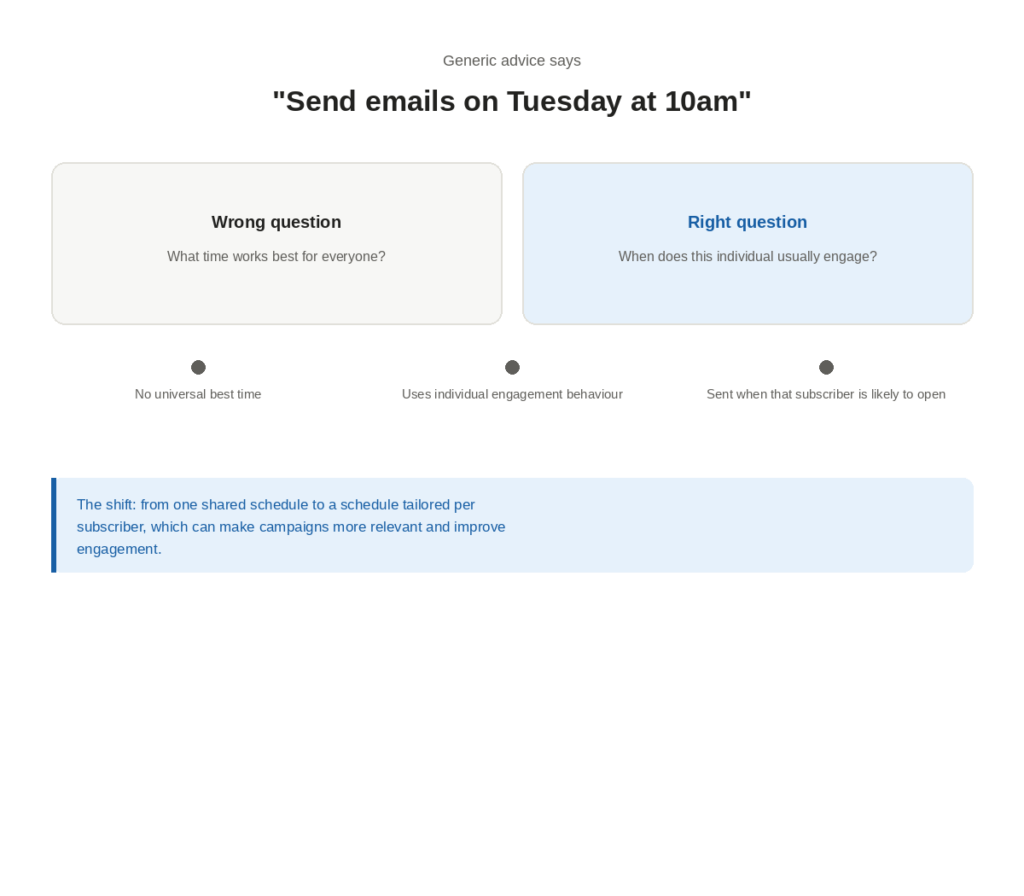
You’ve probably heard advice such as:
“Send emails on Tuesday at 10 a.m.”
The problem is that there is no universal best time for every subscriber.
Send-time optimisation uses individual engagement behaviour to determine when a particular subscriber is most likely to open and engage with an email.
Instead of asking, “What time works best for everyone?”, ask:
“When does this individual subscriber usually engage?”
That shift can make your campaigns more relevant and potentially improve engagement.
5. Build These Four Automated Flows First
Automation is one of the most effective ways to turn email marketing into a consistent revenue channel.
Instead of manually deciding what to send every time, automated workflows respond to customer actions and lifecycle stages.
If you are building your email programme from scratch, start with these four flows:
| Flow | What It Should Do |
| Welcome | Send 3–5 emails. Deliver the first message shortly after signup, then provide value, introduce your brand, add social proof, and finish with a relevant CTA. |
| Abandonment | Follow up after a customer leaves a product or cart behind. Consider reminders around 1 hour, 24 hours, and 72 hours, depending on your buying cycle. |
| Re-engagement | Target subscribers who have been inactive for 60–90 days and give them a clear reason to return. |
| Post-purchase | Thank the customer, provide helpful usage information, request feedback or a review, and introduce relevant cross-sell opportunities. |
These flows cover some of the most important moments in the customer journey — from first interaction to repeat purchase.
The key is not simply to automate more emails. It is to automate useful, timely communication.
6. A Healthy List Beats a Bigger List
A large email database is not necessarily a valuable one.
Over time, email lists naturally accumulate invalid addresses, inactive subscribers, abandoned accounts, and disengaged contacts. Poor list hygiene can negatively affect deliverability, engagement, sender reputation, and revenue.
A smaller, engaged audience can be significantly more valuable than a large database filled with inactive or invalid contacts.
Keep your list healthy by:
- Removing invalid and repeatedly bouncing addresses.
- Re-engaging inactive subscribers before suppressing or removing them.
- Using double opt-in where appropriate to confirm subscriber intent.
- Monitoring engagement and deliverability metrics regularly.
- Sending relevant content instead of relying on constant promotional messages.
- Making unsubscribing easy and transparent.
Watch Your Unsubscribe Rate
If your unsubscribe rate starts climbing, don’t treat it as just another metric.
A sustained increase can indicate problems with:
- Content relevance
- Sending frequency
- Audience targeting
- Segmentation
- Promotional pressure
- Subscriber expectations
Rather than simply trying to reduce unsubscribes, investigate why people are leaving.
Your subscribers are giving you feedback. Pay attention to it.
The 2026 Email Marketing Formula
Getting emails opened is no longer about finding a single “magic” subject line or sending at a supposedly perfect time.
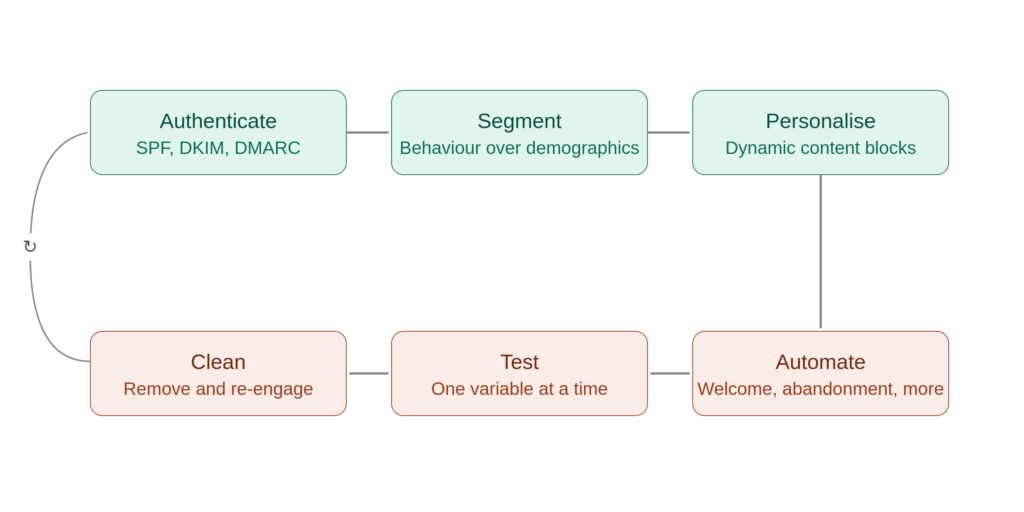
Successful email marketing is built on a system:
Authenticate → Segment → Personalise → Automate → Test → Clean
Start with strong domain authentication and deliverability. Then use behavioural data to understand your audience, personalise the content they receive, automate key customer journeys, test what works, and continuously maintain your list.
The result isn’t simply more open.
It’s a healthier email programme that generates more engagement, stronger customer relationships, and better business results.